

Broadcast Equipment Market Registers a 6.7% CAGR During 2026–2035
Broadcast Equipment market
Broadcast Equipment Market Size, Share and Research Report By Technology (Digital Broadcasting, Analog Broadcasting), By Product (Encoders, Switches & Routers)
Broadcast Equipment Market is expanding as broadcasters adopt advanced production, transmission, and IP-based technologies to enhance content quality and operational efficiency.”
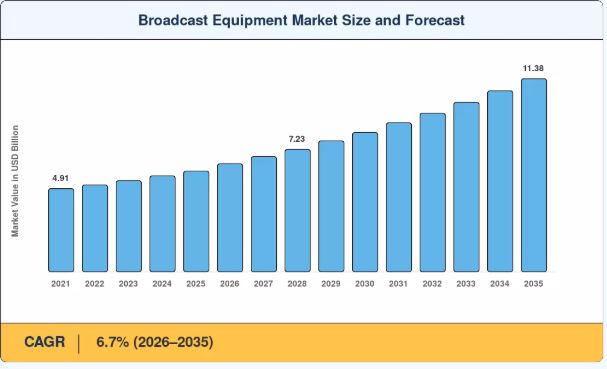
SEOUL, SEOUL, SOUTH KOREA, June 29, 2026 /EINPresswire.com/ -- The Global Broadcast Equipment market was valued at USD 5.95 billion in 2025 and is projected to grow from USD 6.35 billion in 2026 to USD 11.38 billion by 2035, registering a CAGR of 6.7% during the 2026–2035 forecast period. — Market Research Future (MRFR)
This trajectory is anchored by two powerful catalysts government-mandated digital switchover programs with the EU’s revised Audiovisual Media Services Directive compelling full IP migration by 2029 across member states and a global surge in live-streaming advertising spend that topped USD 78 billion in 2024, according to the IAB, growing 31% year-over-year. Together, these forces are converting deferred capital budgets into active procurement cycles across broadcasters, cable network operators, streaming service providers, and production studios worldwide.
Technology transformation sits at the heart of the broadcast equipment market’s expansion. Legacy SDI-based routing matrices and proprietary playout servers are steadily giving way to SMPTE ST 2110 IP fabrics, cloud-native playout engines, and software-defined signal-processing platforms.
The US CHIPS and Science Act allocated USD 1.2 billion toward next-generation media infrastructure R&D through 2028, accelerating adoption of virtualized master-control rooms that reduce rack-space requirements by up to 60%. Broadcasters that once purchased monolithic broadcast hardware are increasingly subscribing to orchestrated microservices, fundamentally reshaping vendor revenue models and establishing cloud playout and SaaS delivery as the broadcast equipment market’s fastest-growing commercial segment.
Get Full PDF Sample Copy of Report: (Including Full TOC, List of Tables & Figures, Chart) @
https://www.marketresearchfuture.com/sample_request/5075
➤How Significant Is the Broadcast Equipment Market’s Growth?
The broadcast equipment market’s trajectory from USD 5.95 billion in 2025 to a projected USD 11.38 billion by 2035 represents nearly a doubling over the forecast decade, underpinned by the structural convergence of regulatory digital transition mandates, OTT and live-streaming platform investment, and the generational IP migration that is converting analog and SDI-based broadcast infrastructure into software-defined, IP-native facilities.
Digital broadcasting captured approximately 70.4% of the broadcast equipment market in 2025, driven by mandatory analog-to-digital transition schedules across 140+ countries, while analog broadcasting equipment shipments are declining at a −3.8% annual rate as spectrum refarming frees bandwidth for mobile operators. Encoders held a 26.1% product-level demand share, reflecting growing need for multi-codec compression across HEVC, AV1, and VVC standards serving heterogeneous end-device ecosystems.
broadcasting represented the largest application segment at 64.8% share, while internet live streaming is advancing at the fastest application-level CAGR of 7.7% through 2035. Broadcasters accounted for 57.0% of end-user demand in 2025, but streaming service providers are recording the fastest end-user segment CAGR of 8.0%, reflecting the continuing shift of sports rights, live event coverage, and entertainment programming toward OTT delivery platforms.
➤What Does the Future Hold for the Broadcast Equipment Market?
OTT and live-streaming spend expansion is the single largest driver of broadcast equipment market growth, contributing approximately 22% to the CAGR. The global live-streaming advertising revenue surge reaching USD 78 billion in 2024 and growing 31% year-over-year directly translates into demand for low-latency encoders, adaptive-bitrate transcoders, and origin-server infrastructure capable of handling concurrent audiences routinely exceeding 20 million viewers during tentpole live sports and entertainment events.
Sports rights holders, streaming platforms, and sports leagues are investing heavily in dedicated live-broadcast production infrastructure to differentiate their streaming offerings, creating a structural and sustained demand category that was not present at this scale a decade ago.
IP migration and SMPTE ST 2110 adoption represents a generational capital replacement cycle for the broadcast equipment market. The EBU’s 2024 Technology Pyramid report found that 62% of European public broadcasters had committed capital budgets for full ST 2110 facility builds by 2028, unlocking operational savings of 35–45% on signal-routing hardware while enabling multisite resource sharing.
This migration requires significant investment in PTP-synchronized network switches, software-defined routing platforms, and cybersecurity appliances product categories in which specialized broadcast equipment vendors are competing intensely against IT networking generalists entering the broadcast infrastructure market.
Digital switchover mandates from the ITU’s Geneva-06 Agreement framework, which pushed over 140 nations to complete or schedule full digital transitions, are reinforcing this capital cycle with India’s Phase-III digitization order alone triggering USD 2.1 billion in cumulative equipment procurement between 2022 and 2025.
Artificial intelligence is graduating from experimental pilots to production-grade deployment across broadcast workflows, establishing a durable long-term demand vector for AI-integrated broadcast equipment and software platforms. AWS Elemental and Grass Valley launched AI-powered automated quality-control modules in 2024 that reduced manual compliance-review hours by 70%, and compute-dense GPU appliances are being integrated into broadcast signal chains for real-time automated closed-captioning, content classification, and highlight extraction.
As inference engines move to the edge and AI-driven production automation matures, the broadcast equipment market stands to capture incremental hardware and software-license revenue from AI integration across ingest, playout, and distribution workflows — fundamentally transforming the product and service mix of leading equipment vendors.
➤ Who Are the Key Players in the Broadcast Equipment Market?
The broadcast equipment market is served by a specialized group of broadcast technology companies with deep expertise in video signal processing, encoding, routing, and IP infrastructure, alongside major consumer electronics companies with professional broadcast divisions. MRFR identifies the following key participants:
✿Grass Valley (a Belden brand) — a global leader in broadcast production and playout infrastructure, offering cameras, production switchers, routers, multiviewers, and AI-powered automated quality-control systems widely deployed across major broadcast networks, sports production facilities, and public broadcasters worldwide.
✿Harmonic Inc. — a leading provider of video infrastructure and streaming solutions for broadcasters and streaming service providers, specializing in high-efficiency encoding, cloud-native playout, and adaptive-bitrate transcoding platforms serving major pay-TV operators, sports broadcasters, and OTT streaming services globally.
✿Evertz Microsystems Ltd. — a major supplier of broadcast infrastructure and signal-processing solutions, providing routing systems, multiviewers, signal processors, and IP infrastructure platforms for television broadcasters, production houses, and cable network operators across North America, Europe, and Asia-Pacific.
✿Imagine Communications — a broadcast software and infrastructure technology company providing cloud-native playout, scheduling, traffic, and signal-processing solutions for major broadcast networks, streaming platforms, and cable operators transitioning from traditional SDI to IP-native broadcast workflows.
✿EVS Broadcast Equipment — a Belgian specialist in live video production technology, providing instant replay systems, live production servers, and sports broadcast workflow solutions deployed at major international sporting events including the FIFA World Cup and Olympic Games.
✿Ross Video — a Canadian broadcast and live production technology company offering production switchers, clip servers, character generators, and automation systems widely used in television studios, sports venues, and live event production environments globally.
✿Blackmagic Design — an Australian broadcast and production equipment manufacturer known for democratizing professional video technology through its DaVinci Resolve editing platform, ATEM production switchers, and HyperDeck broadcast recorders, serving both professional broadcasters and a rapidly growing independent production community.
✿Sony Group Corporation (Professional Solutions) — a major provider of professional broadcast cameras, monitors, production switchers, and IP-enabled broadcast infrastructure through its Sony Professional Solutions division, serving major broadcasters, production studios, and live event operators with cinema-grade imaging technology.
Competitive dynamics in the broadcast equipment market are increasingly defined by the depth of cloud-native playout and SaaS platform capabilities, the ability to integrate AI-powered production automation within traditional hardware product lines, and strategic positioning as trusted IP migration partners for the world’s major public and commercial broadcasters during the generational transition from SDI to IP-native facility architectures.
➤ What Are the Emerging Trends in the Broadcast Equipment Market?
Several transformational trends are redefining the broadcast equipment market’s evolution through 2035:
Digital Switchover Mandates Driving Equipment Replacement Cycles: The ITU’s Geneva-06 Agreement framework has pushed over 140 nations to complete or schedule full analog-to-digital broadcast transitions, with Southeast Asian and African nations now entering their compliance windows. India’s Phase-III digitization order triggered USD 2.1 billion in cumulative broadcast equipment procurement between 2022 and 2025, covering headend encoders, multiplexers, and conditional-access modules for over 450 cable operators — a template being replicated across emerging markets.
OTT & Live-Streaming Infrastructure Investment: Global live-streaming advertising revenue reaching USD 78 billion in 2024 — growing 31% year-over-year — is driving sustained capital investment in low-latency encoder infrastructure, origin-server capacity, and adaptive-bitrate transcoding platforms capable of supporting concurrent live audiences exceeding 20 million viewers during major sports and entertainment events.
IP Migration & SMPTE ST 2110 Facility Builds: The transition from SDI-based routing matrices to IP-native SMPTE ST 2110 broadcast facility architectures is reshaping the competitive landscape for broadcast equipment vendors. With 62% of European public broadcasters committed to full ST 2110 builds by 2028, this migration is generating a multi-year capital replacement cycle delivering 35–45% operational savings on signal-routing hardware alongside new investment in PTP-synchronized switches and cybersecurity infrastructure.
AI-Powered Production Automation: AI-driven automated quality control, real-time closed-captioning, content classification, and highlight extraction are being integrated into production broadcast workflows by vendors including Grass Valley and AWS Elemental, with deployments reducing manual compliance-review hours by up to 70% and establishing AI-integrated broadcast equipment as a premium product tier commanding above-average margin.
Cloud-Native Playout & SaaS Revenue Models: Cloud-native playout engines from vendors including Harmonic and Imagine Communications are enabling broadcasters to migrate from capital-intensive on-premise playout infrastructure to subscription-based, cloud-orchestrated models that reduce rack-space requirements by up to 60% and enable multisite redundancy without hardware duplication.
5G Contribution & Backhaul Expansion: The maturation of 5G fixed-wireless broadcast contribution links is enabling low-cost, license-free live video contribution from remote production locations, disrupting the traditional satellite uplink market and creating new demand for 5G-compatible encoder and bonded-cellular transmission equipment across news, sports, and live event broadcast production workflows.
Get access to the full description of the report @
https://www.marketresearchfuture.com/reports/broadcast-equipment-market-5075
➤ How Is the Broadcast Equipment Market Segmented?
The broadcast equipment market report provides a comprehensive segmentation framework:
By Technology: Digital Broadcasting, Analog Broadcasting
By Product: Encoders, Switches & Routers, Dish Antennas, Transmitters, Others
By Application: Television Broadcasting, Internet Live Streaming, Radio Broadcasting, Satellite Broadcasting
By End User: Broadcasters, Cable Network Operators, Streaming Service Providers, Production Studios
By Region: North America, Europe, Asia-Pacific, South America, Middle East and Africa
➤ What Are the Regional Insights from the Broadcast Equipment Market?
North America commands the largest share of the global broadcast equipment market at 35.5% of worldwide revenue in 2025, led by ATSC 3.0 next-generation television standard rollouts across US commercial broadcasters and aggressive OTT platform infrastructure investment from major streaming services.
The United States’ mature cable and broadcast television infrastructure, combined with the scale of its sports rights ecosystem and live event production industry, positions North America as both the market’s revenue leader and its primary technology innovation center. The US CHIPS and Science Act’s USD 1.2 billion media infrastructure R&D allocation is further reinforcing the region’s equipment upgrade cycle.
Europe holds the second-largest regional share at approximately 26.2%, backed by EBU-coordinated IP migration frameworks and the EU’s Audiovisual Media Services Directive compelling full IP migration by 2029. European public broadcasters — including the BBC, ARD, France Télévisions, and RAI — represent some of the world’s most technically demanding broadcast equipment procurement programs, with SMPTE ST 2110 facility build commitments driving sustained high-value investment in IP routing, signal processing, and cloud-native playout infrastructure across the region.
Asia-Pacific is the fastest-growing regional market at a projected 7.6% CAGR through 2035 — the highest of any region globally — propelled by India’s Phase-III cable digitization mandate, Japan’s NHK broadcast modernization program, and China’s national broadcasting infrastructure upgrade under the State Administration of Radio and Television’s digital transition framework. India’s digitization program alone triggered USD 2.1 billion in broadcast equipment procurement between 2022 and 2025, establishing the subcontinent as one of the world’s most active broadcast capital investment markets and creating a template that neighboring Southeast Asian markets are beginning to replicate.
South America and the Middle East & Africa represent emerging growth markets for broadcast equipment, with adoption driven by government-mandated digital television transition programs across Brazil, sub-Saharan Africa, and the Gulf Cooperation Council states. Brazil’s ISDB-Tb digital television standard rollout and Africa’s ITU-coordinated digital switchover program — covering 54 nations — are generating sustained demand for headend encoders, distribution equipment, and conditional-access systems across these regions, expected to support above-average growth rates in the broadcast equipment market through 2035.
➤➤➤ Industry Analysis Reports by Market Research Future:
Nano Robots Market
https://www.marketresearchfuture.com/reports/nano-robots-market-22497
Cloud Computing Banking Market
https://www.marketresearchfuture.com/reports/cloud-computing-banking-market-22577
Light Sensor Market
https://www.marketresearchfuture.com/reports/light-sensor-market-22667
Debt Security Market
https://www.marketresearchfuture.com/reports/debt-security-market-22786
Business Insurance Market
https://www.marketresearchfuture.com/reports/business-insurance-market-22853
Wearable Robotic Exoskeleton Market
https://www.marketresearchfuture.com/reports/wearable-robotic-exoskeleton-market-22855
Commercial Auto Insurance Market
https://www.marketresearchfuture.com/reports/commercial-auto-insurance-market-23496
Led Stadium Screens Market
https://www.marketresearchfuture.com/reports/led-stadium-screens-market-23849
Prepaid Cards Market
https://www.marketresearchfuture.com/reports/prepaid-cards-market-23856
Compulsory Third Party Insurance Market
https://www.marketresearchfuture.com/reports/compulsory-third-party-insurance-market-23867
Sagar Kadam
Market Research Future
+ + +1 628-258-0071
email us here
Visit us on social media:
LinkedIn
Facebook
YouTube
X
Legal Disclaimer:
EIN Presswire provides this news content "as is" without warranty of any kind. We do not accept any responsibility or liability for the accuracy, content, images, videos, licenses, completeness, legality, or reliability of the information contained in this article. If you have any complaints or copyright issues related to this article, kindly contact the author above.
