

Lunar Exploration Technology Market 2026 Expanding Space Missions Accelerating Technology Development
lunar exploration technology market opportunity
lunar exploration technology market analysis
lunar exploration technology market size
The Business Research Company's Lunar Exploration Technology Market 2026 Expanding Space Missions Accelerating Technology Development
LONDON, GREATER LONDON, UNITED KINGDOM, March 18, 2026 /EINPresswire.com/ -- "Lunar Exploration Technology Market to Surpass $21 billion in 2030. In comparison, the Commercial Aircraft which is considered as its parent market, is expected to be approximately $272 billion by 2029, with Lunar Exploration Technology market to represent around 8% of the parent market. Within the broader Aerospace & Defense industry, which is expected to be $1,166 billion by 2029, the Lunar Exploration Technology market is estimated to account for nearly 2% of the total market value.
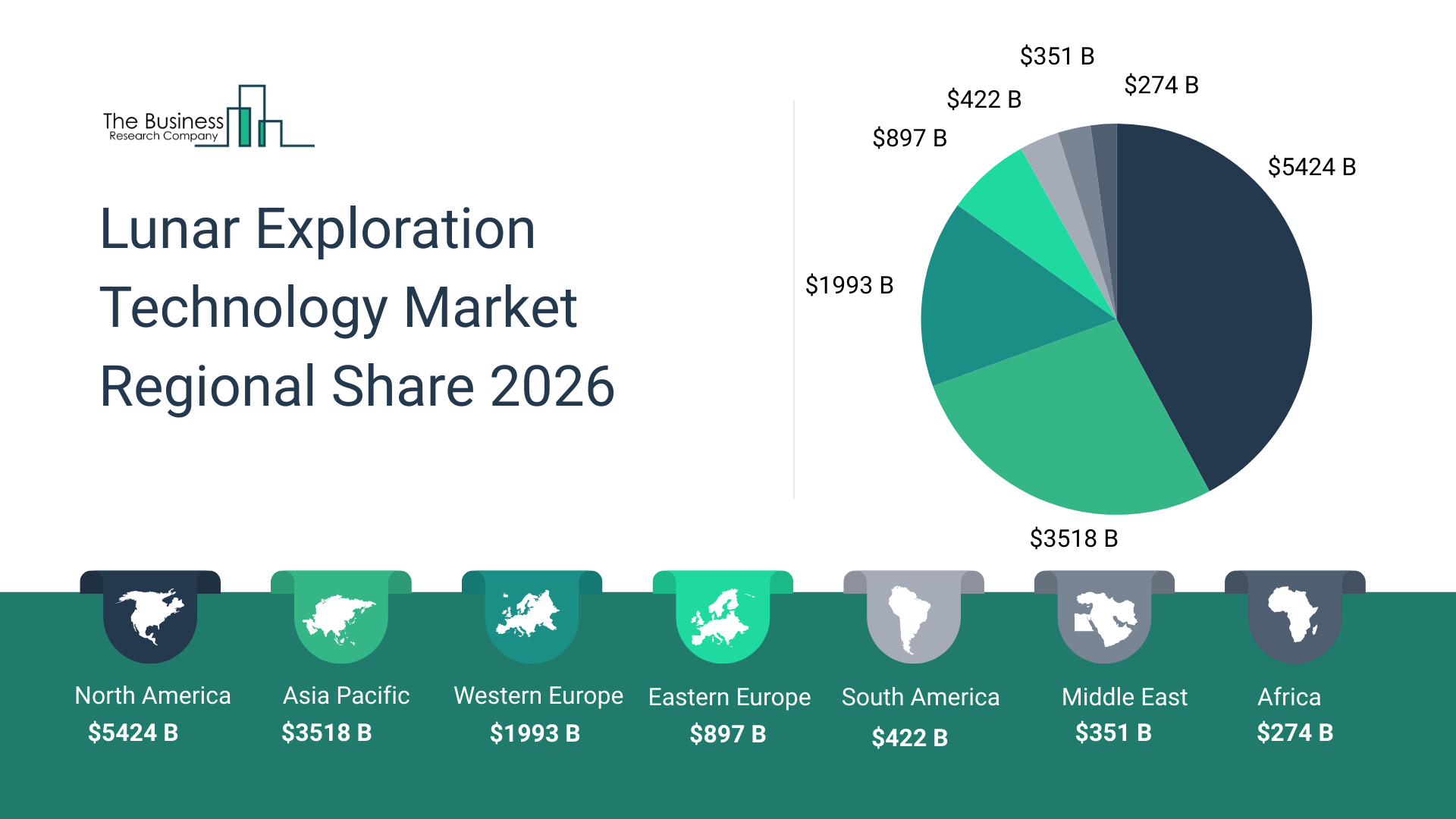
Which Will Be the Biggest Region in the Lunar Exploration Technology Market in 2030
North America will be the largest region in the lunar exploration technology market in 2030, valued at $8,369 million. The market is expected to grow from $4,874 million in 2025 at a compound annual growth rate (CAGR) of 11%. The rapid growth can be attributed to the improvements in lunar landing systems and long-term budget commitments for moon-to-mars programs.
Which Will Be The Largest Country In The Lunar Exploration Technology Market In 2030?
The USA will be the largest country in the lunar exploration technology market in 2030, valued at $7,279 million. The market is expected to grow from $4,301 million in 2025 at a compound annual growth rate (CAGR) of 11%. The rapid growth can be attributed long-term budget commitments for moon-to-mars programs and establishment of sustained lunar surface infrastructure.
Request a free sample of the Lunar Exploration Technology Market report:
https://www.thebusinessresearchcompany.com/sample_request?id=27694&type=smp&utm_source=EINPresswire&utm_medium=Paid&utm_campaign=Mar_PR
What will be Largest Segment in the Lunar Exploration Technology Market in 2030?
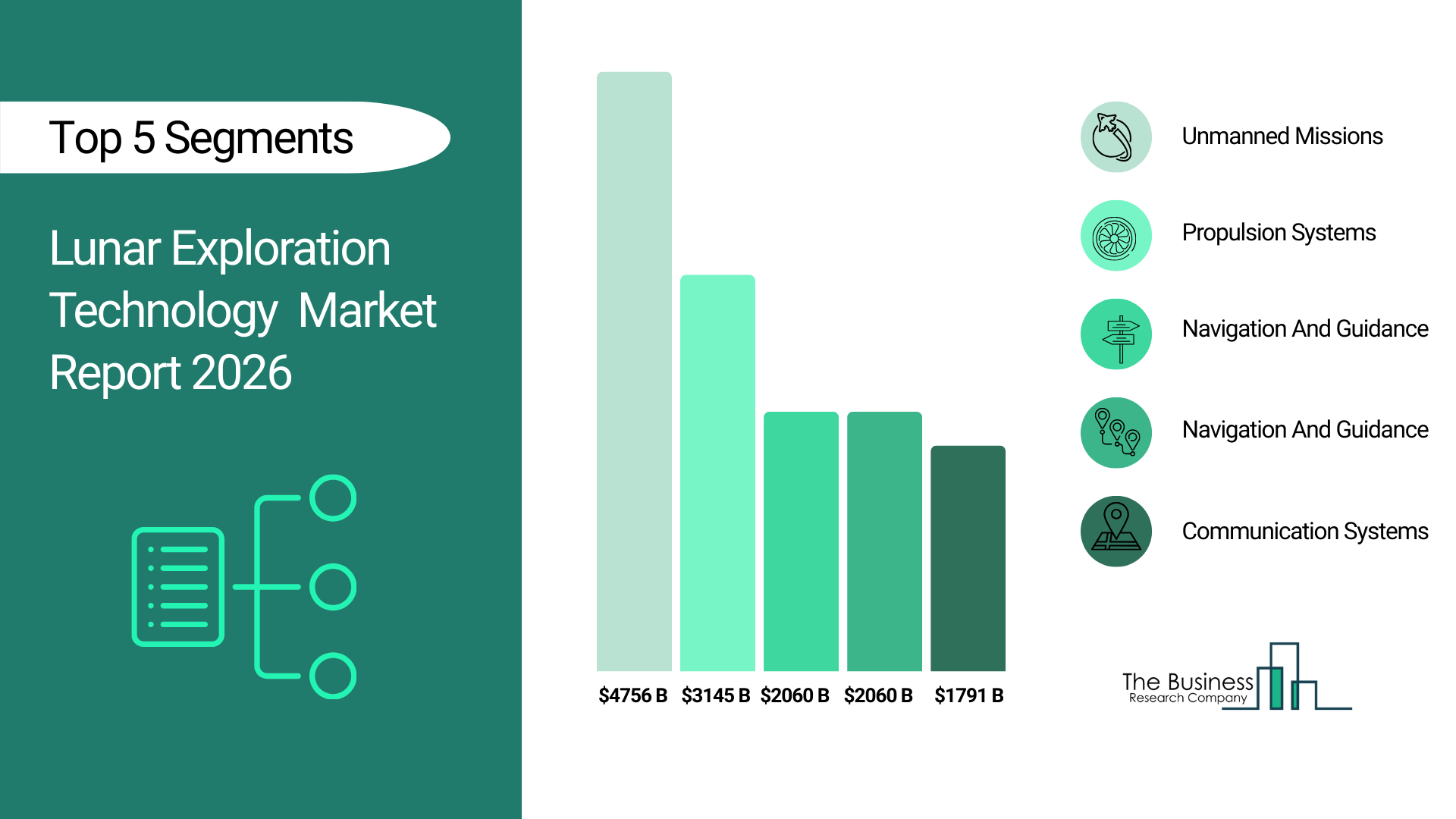
The lunar exploration technology market is by technology type into propulsion systems, landing systems, navigation and guidance, communication systems, power systems, robotics and automation, scientific instruments and other technology types. The propulsion systems market will be the largest segment of the lunar exploration technology market segmented by technology type, accounting for 23% or $4,934 million of the total in 2030. The propulsion systems market will be supported by increasing lunar missions by government and private space agencies, growing investments in reusable and high-efficiency rocket engines, rising demand for deep space and cargo transportation capabilities, advancements in electric and hybrid propulsion technologies, expanding international lunar exploration programs, increasing focus on cost-effective launch systems, and the development of sustainable propellants for long-duration missions.
The lunar exploration technology market is segmented by application into manned missions, unmanned missions, lunar rovers, lunar landers, lunar orbiters and other applications. The unmanned mission market will be the largest and fastest-growing segment of lunar exploration technology market segmented by application, accounting for 39% or $8,159 million of the total in 2030. The unmanned mission market will be supported by lower mission costs compared to crewed missions, increasing frequency of robotic exploration programs, rising demand for lunar mapping and reconnaissance, technological advancements in autonomous spacecraft systems, expanding international participation in lunar missions, growing commercial satellite deployment, and rapid innovation in small satellite technologies.
The lunar exploration technology market is segmented by end-user into into government space agencies, commercial space companies, research institutes and other end-users. The government space agencies segment market will be the largest segment of lunar exploration technology market segmented by end-user, accounting for 58% or $12,112 million of the total in 2030. The government space agencies market will be supported by national strategic space exploration programs, increasing public funding for lunar missions, geopolitical competition in space dominance, expansion of international cooperation agreements, long-term scientific research objectives, investments in advanced space infrastructure, and policy initiatives promoting lunar exploration and resource utilization.
What is the expected CAGR for the Lunar Exploration Technology Market leading up to 2030?
The expected CAGR for the lunar exploration technology market leading up to 2030 is 13%.
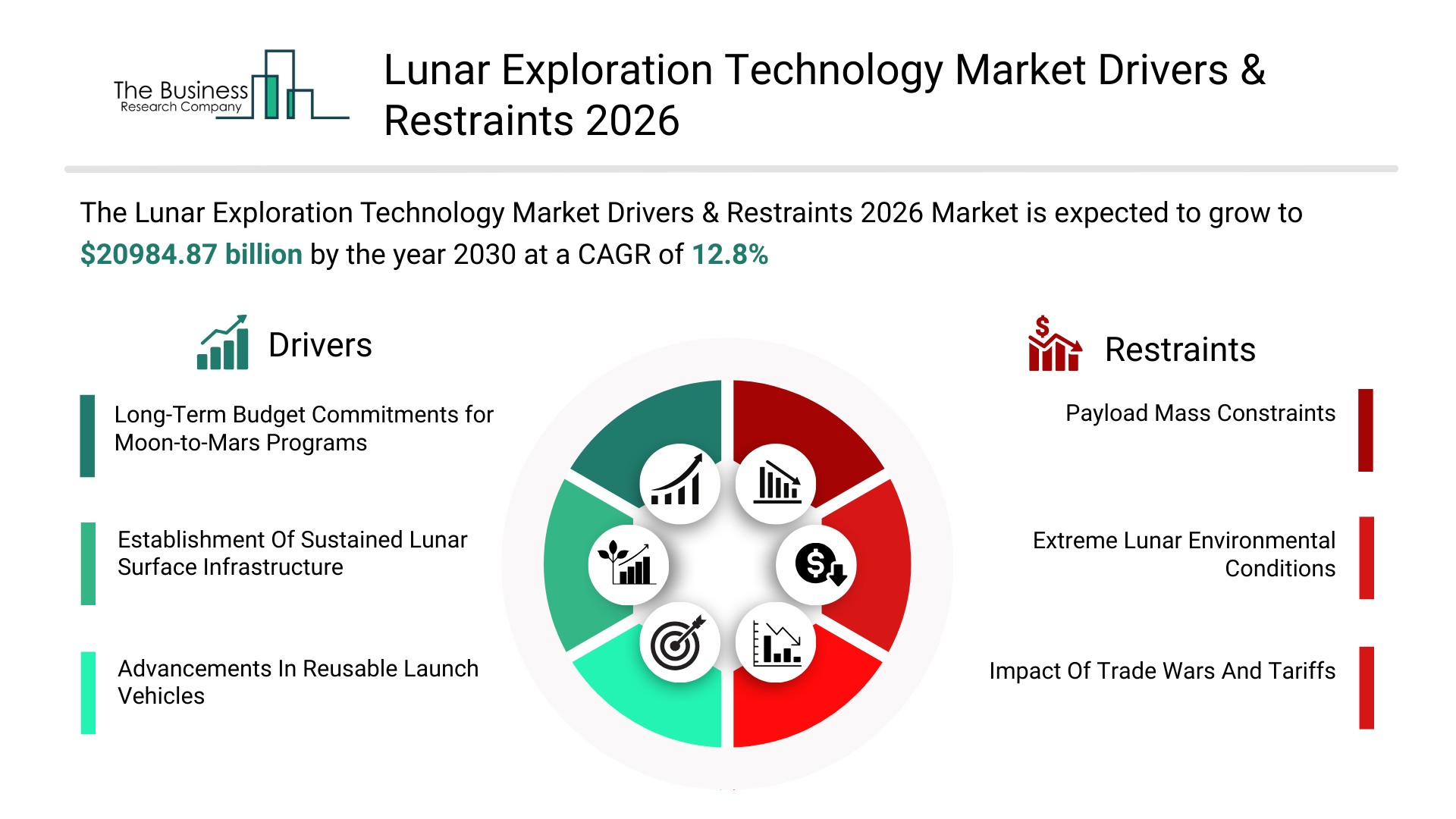
What Will Be The Growth Driving Factors In The Lunar Exploration Technology Market In The Forecast Period?
The rapid growth of the global lunar exploration technology market leading up to 2030 will be driven by the following key factors that are expected to reshape Space infrastructure, industrial supply-chains, mission procurement, and strategic access to extraterrestrial resources worldwide.
Long-Term Budget Commitments For Moon-To-Mars Programs – The long-term budget commitments for Moon-to-Mars programs is expected to propel the growth of the lunar exploration technology market. Lunar exploration technology acts as a proving ground for systems, infrastructure and mission operations that are directly reusable for Moon-to-Mars programs, reducing uncertainty and spreading development costs over multiple missions. Continuous lunar missions enable phased investment, hardware reuse and incremental testing, which supports structured long-term budget commitments instead of one-time high-risk spending. NASA’s FY2026 budget request outlines sustained multi-year funding commitments for Moon-to-Mars programs, with continued support for transportation systems, exploration infrastructure and mission development through the end of the decade. It reinforces long-term investment in lunar missions and Mars preparation capabilities, ensuring continuity of Artemis and related deep space exploration efforts and long-term budget commitments for Moon-to-Mars programs may drive the growth of the lunar exploration technology. As a result, the long-term budget commitments for Moon-to-Mars programs is anticipated to contributing to a is 2.0% annual growth in the market.
Establishment Of Sustained Lunar Surface Infrastructure – The establishment of sustained lunar surface infrastructure is expected to propel the growth lunar exploration technology market. Sustained lunar surface infrastructure refers to long-duration, continuously operating systems and facilities on the Moon, such as habitats, power units, communication networks, mobility platforms and resource processing setups that support repeated or permanent missions rather than short visits and lunar exploration technology enables this through advanced landers, autonomous construction, in situ resource utilization, precision navigation and reliable surface power and life support systems, collectively reducing resupply dependence and enabling stable, scalable and long-term human and robotic operations on the lunar surface. NASA and the Department of Energy are collaborating to develop a lunar surface nuclear fission reactor targeted for deployment by 2030 to support long-duration Moon missions. The planned reactor is designed to deliver continuous and reliable power on the lunar surface, helping overcome limits from long lunar nights and harsh environmental conditions. This power capability is intended to enable sustained lunar surface infrastructure, including habitats, science systems and operational technologies for ongoing exploration and the establishment of sustained lunar surface infrastructure may drive the growth of the lunar exploration technology market. Consequently, the establishment of sustained lunar surface infrastructure is projected to contributing to a 1.8% annual growth in the market.
Advancements In Reusable Launch Vehicles – The advancements in reusable launch vehicles is expected to propel the growth of the lunar exploration technology market in the forecast period. Lunar Exploration Technology accelerates advancements in reusable launch vehicles by driving demand for frequent, cost-efficient and high-payload missions to and from the Moon. To support repeated lunar missions, agencies and private firms invest in reusable boosters, landers and deep-space-capable stages that can be refurbished and reflown. This continuous mission cycle improves reusability design, turnaround time and reliability, directly strengthening reusable launch vehicle capabilities. Reusable rockets are transforming space exploration by providing a more sustainable and cost-effective alternative to traditional expendable rockets, highlighting technological advances like SpaceX’s Falcon 9. It explains the scientific principles, historical development and engineering innovations that make reusability possible and discusses how these technologies lower launch costs and environmental impact. Therefore, the advancements in reusable launch vehicles is projected to contributing to a 1.3% annual growth in the market.
Improvements In Lunar Landing Systems – The improvements in lunar landing systems is expected to propel the growth of the lunar exploration technology market in the forecast period. Lunar exploration technology supports improvement in lunar landing systems through advances in precision navigation, autonomous guidance and hazard detection that enable safer and more controlled surface descent, while modern propulsion and sensor systems improve landing accuracy and stability. Continuous mission testing, simulation and surface mapping enhance system reliability and decision-making during descent and touchdown, strengthening overall landing performance across missions. Multiple missions showed clear progress in lunar landing systems through improved propulsion testing, escape systems and precision landing technologies aimed at safer crewed and robotic Moon missions. Commercial landers under NASA partnership programs achieved successful soft landings, proving better navigation, guidance and surface operation capability. At the same time, partial mission failures highlighted remaining reliability gaps, driving further refinement and testing of lunar landing hardware and control systems and improvement in lunar landing systems may drive the growth of the lunar exploration technology market. Consequently, improvements in lunar landing systems is projected to contributing to a 0.8% annual growth in the market.
Access the detailed Lunar Exploration Technology Market report here:
https://www.thebusinessresearchcompany.com/report/lunar-exploration-technology-global-market-report?utm_source=EINPresswire&utm_medium=Paid&utm_campaign=Mar_PR
What Are The Key Growth Opportunities In The Lunar Exploration Technology Market in 2029?
The most significant growth opportunities are anticipated in public sector lunar exploration and space technology market, the autonomous lunar missions and exploration technology market and the advanced lunar propulsion and exploration technology. Collectively, these segments are projected to contribute over $11 billion in market value by 2030, driven by rising government investments in deep-space exploration programs, increasing international collaboration on lunar infrastructure development, and rapid advancements in propulsion, robotics, and AI-enabled navigation systems. Expanding initiatives focused on establishing sustainable lunar bases, in-situ resource utilization (ISRU), and commercial payload deployment are further accelerating demand for next-generation exploration platforms. This growth reflects the intensifying global focus on strategic space capabilities, scientific discovery, and long-term lunar commercialization, positioning the broader lunar exploration technology market as a transformative force in the future space economy.
The public sector lunar exploration and space technology market is projected to grow by $5,001 million, the autonomous lunar missions and exploration technology market by $3,991 million and the advanced lunar propulsion and exploration technology market by $2,116 million over the next five years from 2025 to 2030.
The Business Research Company (www.thebusinessresearchcompany.com) is a leading market intelligence firm renowned for its expertise in company, market, and consumer research. We have published over 17,500 reports across 27 industries and 60+ geographies. Our research is powered by 1,500,000 datasets, extensive secondary research, and exclusive insights from interviews with industry leaders.
We provide continuous and custom research services, offering a range of specialized packages tailored to your needs, including Market Entry Research Package, Competitor Tracking Package, Supplier & Distributor Package and much more
Disclaimer: Please note that the findings, conclusions and recommendations that TBRC Business Research Pvt Ltd delivers are based on information gathered in good faith from both primary and secondary sources, whose accuracy we are not always in a position to guarantee. As such TBRC Business Research Pvt Ltd can accept no liability whatever for actions taken based on any information that may subsequently prove to be incorrect. Analysis and findings included in TBRC reports and presentations are our estimates, opinions and are not intended as statements of fact or investment guidance.
The Business Research Company
Americas +1 310-496-7795
Europe +44 7882 955267
Asia & Others +44 7882 955267 & +91 8897263534
Email: info@tbrc.info"
Oliver Guirdham
The Business Research Company
+44 7882 955267
info@tbrc.info
Visit us on social media:
LinkedIn
Facebook
X
Legal Disclaimer:
EIN Presswire provides this news content "as is" without warranty of any kind. We do not accept any responsibility or liability for the accuracy, content, images, videos, licenses, completeness, legality, or reliability of the information contained in this article. If you have any complaints or copyright issues related to this article, kindly contact the author above.
