

Your media and advertising news reporter
Provided by AGP
Restriction Enzymes Market Expected to Hit US$411.4 Mn by 2033 Amid Rising Demand | Persistence Market Research
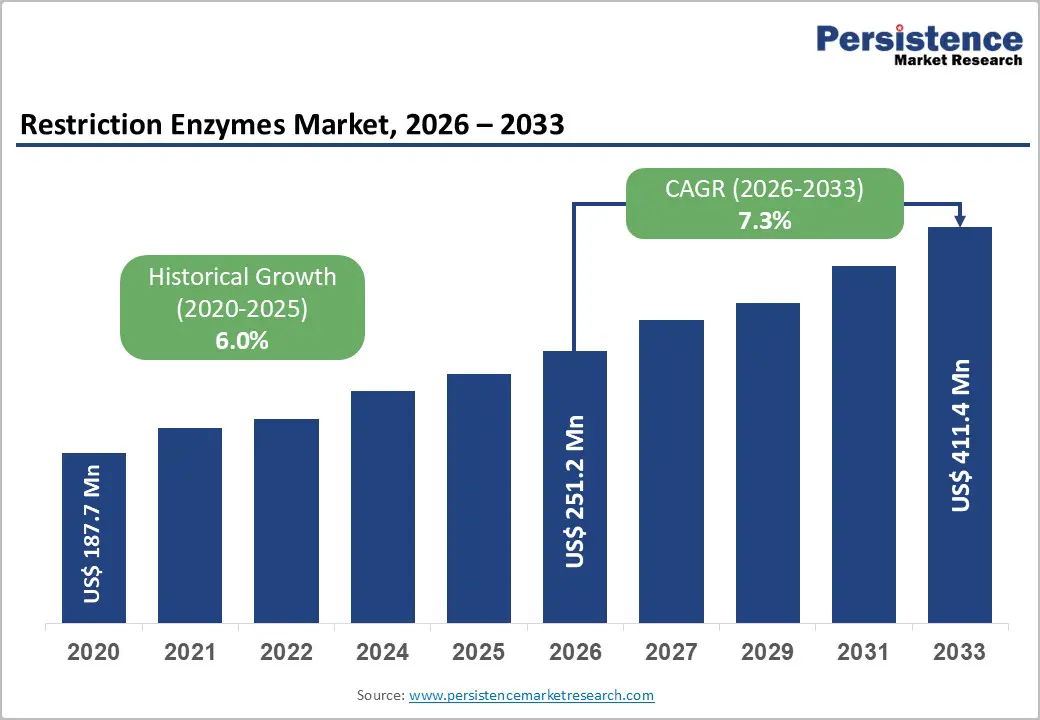
restriction enzymes market
The global restriction enzymes market is expanding rapidly, driven by advances in molecular biology, genomics, diagnostics, and therapeutic research.
LONDON, UNITED KINGDOM, May 12, 2026 /EINPresswire.com/ -- The global restriction enzymes market is poised for significant growth, with the market expected to reach US$251.2 million in 2026 and projected to expand to US$411.4 million by 2033, reflecting a compound annual growth rate (CAGR) of 7.3% between 2026 and 2033. The market’s expansion is primarily driven by sustained demand for cloning, plasmid linearization, sequencing library preparation, and molecular diagnostics. Type II restriction enzymes continue to dominate laboratory consumption, while emerging applications in epigenetics, mRNA manufacturing, and precision medicine are broadening the market landscape.
Market Overview and Key Trends
North America is projected to maintain its leadership in the restriction enzymes market, accounting for 40.8% of global market share. The region benefits from robust research infrastructure, advanced biotechnology capabilities, and the presence of leading life sciences companies. Conversely, Asia Pacific is anticipated to be the fastest-growing region due to rising investments in biotechnology, expanding genomics research, and increasing pharmaceutical manufacturing in countries such as China, India, and Japan. Industry participants are actively investing in enzyme innovation, GMP-grade production, and regional expansion to strengthen supply chains and meet the growing demand in molecular diagnostics and therapeutic applications.
Type II restriction enzymes are expected to remain the dominant product segment, holding 41.6% of the market share due to their extensive use in DNA digestion, cloning, and molecular biology workflows. Cloning applications continue to lead the market, representing approximately 39.2% of total usage, driven by their essential role in recombinant DNA technology, gene expression studies, and plasmid construction.
Market Drivers
Restriction enzymes, particularly Type II, remain foundational in molecular biology for their ability to cleave DNA at specific recognition sequences. These enzymes enable precise DNA manipulation, supporting cloning, vector construction, genome editing, and synthetic biology. Their commercial availability and validated performance across workflows ensure consistent demand in academic, clinical, and industrial research.
The rise of mRNA-based therapeutics and vaccines has further increased the demand for restriction enzymes, especially for plasmid linearization prior to in vitro transcription. High-purity, GMP-compliant enzymes are increasingly required for regulated biomanufacturing environments, elevating their commercial value. Additionally, the expansion of precision medicine, epigenetics, and next-generation sequencing (NGS) applications continues to drive market growth. Enzyme-based workflows in sequencing, methylation studies, and diagnostic assay development are replacing traditional chemical methods, improving data accuracy and sample integrity.
Download Your Free Sample & Explore Key Insights: https://www.persistencemarketresearch.com/samples/36549
Market Restraints
Despite sustained demand, emerging techniques such as seamless cloning, Gibson Assembly, and enzyme-free DNA assembly are reducing reliance on traditional restriction enzyme workflows. These methods allow faster and more flexible DNA assembly, limiting growth in conventional cloning, especially in high-throughput and synthetic biology settings. Regulatory complexity and stringent product formulation requirements also present challenges. The need for animal-free formulations, impurity control, and reproducibility increases manufacturing costs and creates adoption barriers for smaller laboratories.
Market Opportunities
High-value applications in RNA therapeutics and advanced biomanufacturing offer significant growth potential. Enzymes used in plasmid preparation and template linearization are critical for scalable RNA production, with high-performance products commanding premium pricing. Epigenetics and molecular diagnostics represent emerging high-margin segments, driven by enzyme-based DNA modification and methylation analysis. These techniques are increasingly adopted in oncology, rare genetic disorder testing, and infectious disease surveillance, expanding the market for reliable enzyme systems. Asia Pacific’s growing biotechnology and research ecosystem, supported by government initiatives, CROs, and academic infrastructure, further amplifies growth opportunities.
Product Type Insights
Type II enzymes dominate with a 41.6% market share due to their precision and compatibility with standardized laboratory protocols. Widely used enzymes such as EcoRI and HindIII remain staples in cloning workflows, plasmid mapping, and gene expression studies. Type IV enzymes are the fastest-growing segment, addressing demand for methylation-sensitive DNA analysis and epigenetic research. These enzymes are critical in cancer biomarker discovery and gene regulation studies, enhancing their adoption in both research and clinical diagnostics.
Get Custom Insights Designed for Your Businecss: https://www.persistencemarketresearch.com/request-customization/36549
End-User Insights
Academic and research institutes hold 46.8% of the market, reflecting extensive use in gene cloning, sequencing, and laboratory training programs. Biotechnology and pharmaceutical companies are the fastest-growing segment due to increased enzyme usage in drug development, diagnostics, and mRNA production, highlighting the rising importance of GMP-grade solutions in regulated workflows.
Regional Insights
North America remains the innovation-driven leader, with strong genomics integration and automation adoption. Europe emphasizes regulatory compliance, high-purity enzyme innovation, and robust diagnostic applications. Asia Pacific is the fastest-growing region, driven by local manufacturing, government-backed genomics initiatives, and the rising adoption of NGS technologies, positioning the region as a critical hub for both enzyme production and consumption.
Market Segmentation
By Product Type
Type II
Type IV
Type I
Type III
Others
By Application
Cloning
Sequencing
PCR
Restriction Fragment Length Polymorphism (RFLP)
Others
By End-user
Academic & Research Institutes
Biotechnology & Pharmaceutical Companies
Hospitals & Diagnostic Centers
Others
By Region
North America
Europe
East Asia
South Asia & Oceania
Latin America
Checkout Now & Download Complete Market Report: https://www.persistencemarketresearch.com/checkout/36549
Competitive Landscape
The market is fragmented, with global leaders such as Thermo Fisher Scientific, New England Biolabs, and Promega Corporation competing alongside regional players. Companies focus on innovation, product quality, global distribution, regulatory compliance, and market expansion. Strategic collaborations, including Promega’s partnerships with Watchmaker Genomics and EditCo Bio, illustrate ongoing efforts to advance enzyme technology for RNA analysis, cell-based research, and next-generation sequencing applications.
The global restriction enzymes market is set to expand substantially through innovation, regional growth, and rising adoption in therapeutic, diagnostic, and research applications, underscoring its critical role in modern molecular biology.
Read Related Reports:
RNA-based Therapeutics and Vaccines Market: The global RNA-based therapeutics and vaccines market grows from US$ 278.9 Mn in 2026 to US$ 1,367.8 Mn by 2033, at a 25.5% CAGR.
3D Printed Prosthetics Market: The global 3D printed prosthetics market grows from US$ 2.0 Bn in 2026 to US$ 3.5 Bn by 2033, at an 8.3% CAGR during forecast 2026–2033.
Persistence Market Research
Persistence Market Research Pvt Ltd
+1 646-878-6329
email us here
Visit us on social media:
LinkedIn
Instagram
Facebook
YouTube
X
Legal Disclaimer:
EIN Presswire provides this news content "as is" without warranty of any kind. We do not accept any responsibility or liability for the accuracy, content, images, videos, licenses, completeness, legality, or reliability of the information contained in this article. If you have any complaints or copyright issues related to this article, kindly contact the author above.
